

 Chisels – Osteotomes – Mallets
 Breast Dissectors And Spreaders
 Electro Surgical Instruments
 Endoscope
 Liposuction Cannulas Sets
 Liposuction Cannulas With Threaded Fitting
 Liposuction SUPOR Handle Cannulas
 Toomey & 60cc Hub Cannula


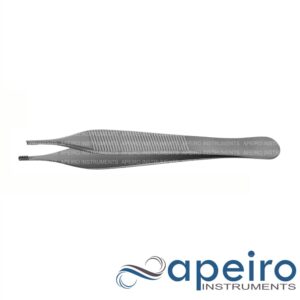
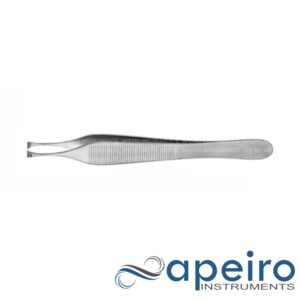
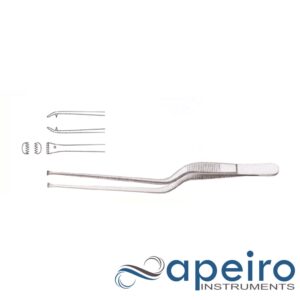
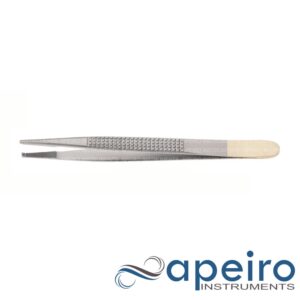
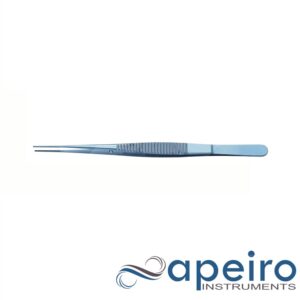
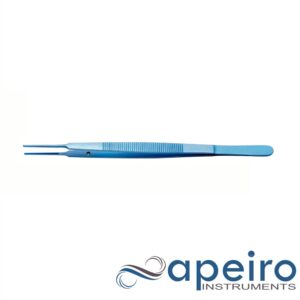
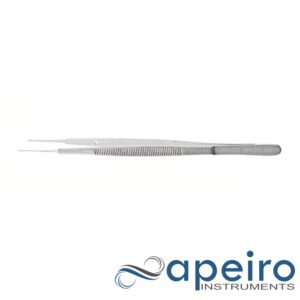
Adson Brown Delicate Tissue Forceps Curved 9X9 Teeth
Price range: $ 12.00 through $ 15.00
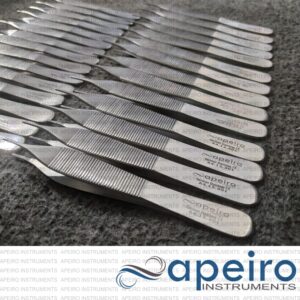
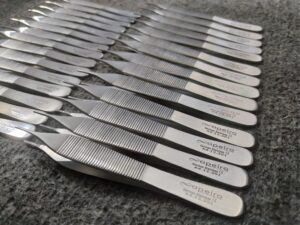
The Adson Brown Delicate Tissue Forceps Curved, 9×9 Teeth, manufactured by Apeiro Instruments, is made from fine stainless steel. Its curved 9×9 teeth tips offer a strong grip with minimal trauma. Durable, reusable, and fully autoclavable. Weight: ~0.040 kg
Overview
Manufactured by Apeiro Instruments, it uses curved tips with 9×9 teeth to provide secure holding without crushing tissue, ideal for closing, fine dissection, or suturing tasks.
Manufacturer: Apeiro Instruments
Material: Stainless Steel
Sterility Condition: Reusable, Autoclavable
Weight: ~0.040 kg
Key Features & Benefits
-
Stainless Steel Construction: Ensures the instrument remains durable, resists corrosion, and stays effective over time.
-
Ergonomic Curved Design: Helps reach awkward angles with better control.
-
Reusable & Autoclavable: Built for repeated use under sterilization without degradation.
Why Choose Apeiro Instruments?
Apeiro Instruments crafts tools that combine precision, safety, and quality. This forceps reflects those values—offering surgical professionals a trusted tool for delicate tissue handling and reliable performance.
Adson Brown Delicate Tissue Forceps Curved 9X9 Teeth.
Their reusable and autoclavable design makes them a cost-effective and sustainable choice for healthcare facilities.
Key Features of Apeiro Instruments’ Adson Brown Delicate Tissue Forceps 9×9 Teeth Curved:
9×9 Teeth: The forceps feature 9 teeth on each jaw, providing a secure grip on a wide range of tissues.
Delicate Tips: The fine, serrated tips minimize tissue trauma and ensure precise handling.
Curved Design: Allows for improved access and manipulation in challenging surgical areas.
Stainless Steel Construction: Guarantees durability, resistance to corrosion, and easy sterilization.
Reusable and Autoclavable: Offers cost-effectiveness and sustainability.
Weight: 0.060 kg
Available Sizes: 12cm (4-3/4″) and 15cm (5-7/8″)
Price Range: $12.00 – $15.00
Adson Brown Delicate Tissue Forceps 9×9 Teeth Curved
Benefits of using Adson Brown Delicate Tissue Forceps 9×9 Teeth Curved:
Enhanced Surgical Precision: The curved design allows for better access and manipulation in challenging surgical areas.
Reduced Trauma: Minimizes tissue damage, leading to faster healing and reduced post-operative complications.
These forceps are an essential tool for any surgical setting that requires precise tissue handling and manipulation.
For more information on Apeiro Instruments and their range of surgical instruments, please visit their website: https://apeiroinstruments.com/
 Weight Weight | 0.060 kg |
|---|---|
 Choose an option Choose an option | 12cm (4-3/4″), 15cm (5-7/8″) |
 Brand ( Manufacturer ) Brand ( Manufacturer ) | Apeiro Instruments |
 Material Material | Stainless Steel |
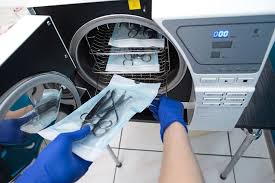 Sterility Condition Sterility Condition | Reusable, Autoclavable |
Instruments Care
Summary: The following are guidelines of Cleaning, Sterilizing & Maintaining surgical instruments.
Use of distilled or deionized water and a neutral pH cleaning solution is recommended for all these procedures.
1. Rinsing-
Immediately after surgery, rinse instruments under warm (not hot) water. It may be helpful to use a nylon toothbrush to rinse the lock boxes and joints of the instrument. Be sure to remove all blood, body fluids, and tissue.
2. Cleaning-
If you do not clean your instruments immediately after rinsing, instruments should be submerged for a in a solution of water and neutral pH (7) detergent. They should never be placed in saline solution, as it may cause corrosion and eventually irreversible damage to the instrument.
A. Ultrasonic Cleaning-
We recommend you manually clean micro & delicate instruments.
Instruments should be processed in a cleaner for the full recommended cycle time- usually 5-10 minutes.
Place instruments in open position into the ultrasonic cleaner. Make sure that sharp blades such as scissors, knives, osteotomes, etc. do not touch other instruments.
All instruments have to be fully submerged.
Do not place dissimilar metals (stainless, copper, chrome plated etc.) in the same cleaning cycle.
Change solution frequently, at least as often as recommended by the manufacturer.
Rinse instruments after ultrasonic cleaning with distilled or deionized water to remove ultrasonic cleaning solution.
B. Automatic Washer Sterilizers-
Follow manufacturers’ recommendations. Make sure instruments are lubricated after last rinse cycle and before sterilization cycle.
C. Manual Cleaning-
Most instrument manufacturers recommend ultrasonic cleaning as the best and most effective way to clean surgical instruments, particularly those with hinges, locks, and other moving parts. If ultra sonic cleaning is not available observe the following steps.
I. Use stiff plastic cleaning brushes (nylon etc.).
Do not use steel wool or wire brushes except specially recommended stainless steel wire brushes for instruments such as bone files, or on stained areas in knurled handles.
II. Use only neutral pH (7) detergents such as the Roboz Instrument Cleaner (IC-1000) or the Roboz Enzymatic Cleaner (EC-1000.) If not rinsed off properly after cleaning, low pH detergents will breakdown the stainless protective surface and cause black staining.
High pH detergent will cause surface deposit of brown stain (this deposit may look like rust) which will also interfere with smooth operation of the instrument.
III. Brush delicate instruments carefully and, if possible, handle them totally separate from general instruments.
IV. Make sure all instrument surfaces are visibly clean and free from stains and tissue.
This is a good time to inspect each instrument for proper function and condition.
Check the following:
Scissor blades glide smoothly from open to closed (they must not be loose when in closed position). Test scissors by cutting into thin gauze. Three quarters of the length of the blade should cut all the way to the scissor tips, and not hang up.
Forceps should have properly aligned tips.
Hemostats and needle holders should not show any light between the jaws. They should lock and unlock easily and the joints should not be too loose. Check needle holders for wear at the tips.
Suction tubes should be clean inside.
Retractors should open, close and lock properly.
Blades of all cutting edges should be sharp and undamaged.
V. After manually scrubbing instruments, rinse them thoroughly under running water (distilled water is best). While rinsing, open and close scissors, hemostats, needle holders and other hinged instruments to make sure the hinge areas are rinsed out, as well as the outside of the instruments.
3. After Cleaning-
If the instruments are to be stored, let them air dry and store them in a clean and dry environment.
4. Autoclaving-
If instruments are to be reused or autoclaved:
A. Lubricate all instruments which have any metal to metal action such as scissors, hemostats, needle holders, and retractors.
B. Use disposable paper or plastic pouches to sterilize individual instruments. Make sure you use a wide enough pouch (4” or wider) for instruments with ratchet locks such as needle holders and hemostats so the instrument can be sterilized in the open and unlocked position.
If you are autoclaving instrument sets unlock all instruments and sterilize them in an open position. Place heavy instruments at the bottom of the set (when two layers are required).
Never lock an instrument during autoclaving. It will not be sterile as the steam cannot reach the metal to metal surfaces. The instrument might develop cracks in hinged areas caused by the heat expansion during the autoclave cycle.
Do not overload the autoclave chamber. Pockets may form that do not permit steam penetration. Place a towel on bottom of pan to absorb excess moisture during autoclaving. This will reduce the chance of getting “wet packs”. Make sure the towels used in sterilization of the instruments have no detergent residue and are neutral pH(7) if immersed in water. The residue of the inexpensive, high-pH (9-13) detergents used by some laundries to clean the towels could cause stains on some instruments.
CAUTION: At the end of the autoclave cycle- before the drying cycle- unlock the autoclave door and open it more than a crack about ¾”. Then run the dry cycle for the period recommended by the autoclave manufacturer. If the autoclave door is opened fully before the drying cycle, cold room air will rush into the chamber, causing condensation on the instruments. This will result in water stains on the instruments and cause “wet packs”.
If you have unusual staining on your instruments during sterilization contact your local instrument representative or look in our web site under staining.
5. Cold Sterilization-
Most cold sterilization solutions render instruments sterile only after a 10 hour immersion. This prolonged chemical action can be more detrimental to the surgical instruments than the usual 20 minute autoclave cycle. If the instruments need to be disinfected only, cold sterilization is recommended since disinfection will take place in only 10 minutes.
Keep in mind the difference between STERILE and DISINFECTED: Sterile- an absolute term (no living organism survives); Disinfected- basically clean.
Always use the proper sterilization/cleaning technique to render the instrument in required condition for use.
Important: For instruments with tungsten carbide inserts such as needle holders, scissors, and tissue








Reviews
Clear filtersThere are no reviews yet.